Flux Foundation & XDAO: The Governance Model Defying DAO Standards
How Flux funds its ecosystem without ICO, VC, or massive treasury. 94.7% community-owned tokens, yield-based Foundation, and XDAO 2.0 democratized governance.
Flux Foundation & XDAO: The Decentralized Governance Model Defying DAO Standards
How to fund a blockchain ecosystem without ICO, without VC, and without massive treasury
In 2025, DAO treasuries total $24.5 billion according to CoinLaw, with Uniswap DAO dominating at $5.4 billion and MakerDAO controlling parameters affecting billions in DAI stablecoins. These impressive figures, however, mask a problematic reality: concentration of voting power (less than 0.1% of holders sometimes control 90% of votes), governance attacks (Compound DAO lost $24 million in 2024), and dependence on treasuries built during ICOs or VC raises.
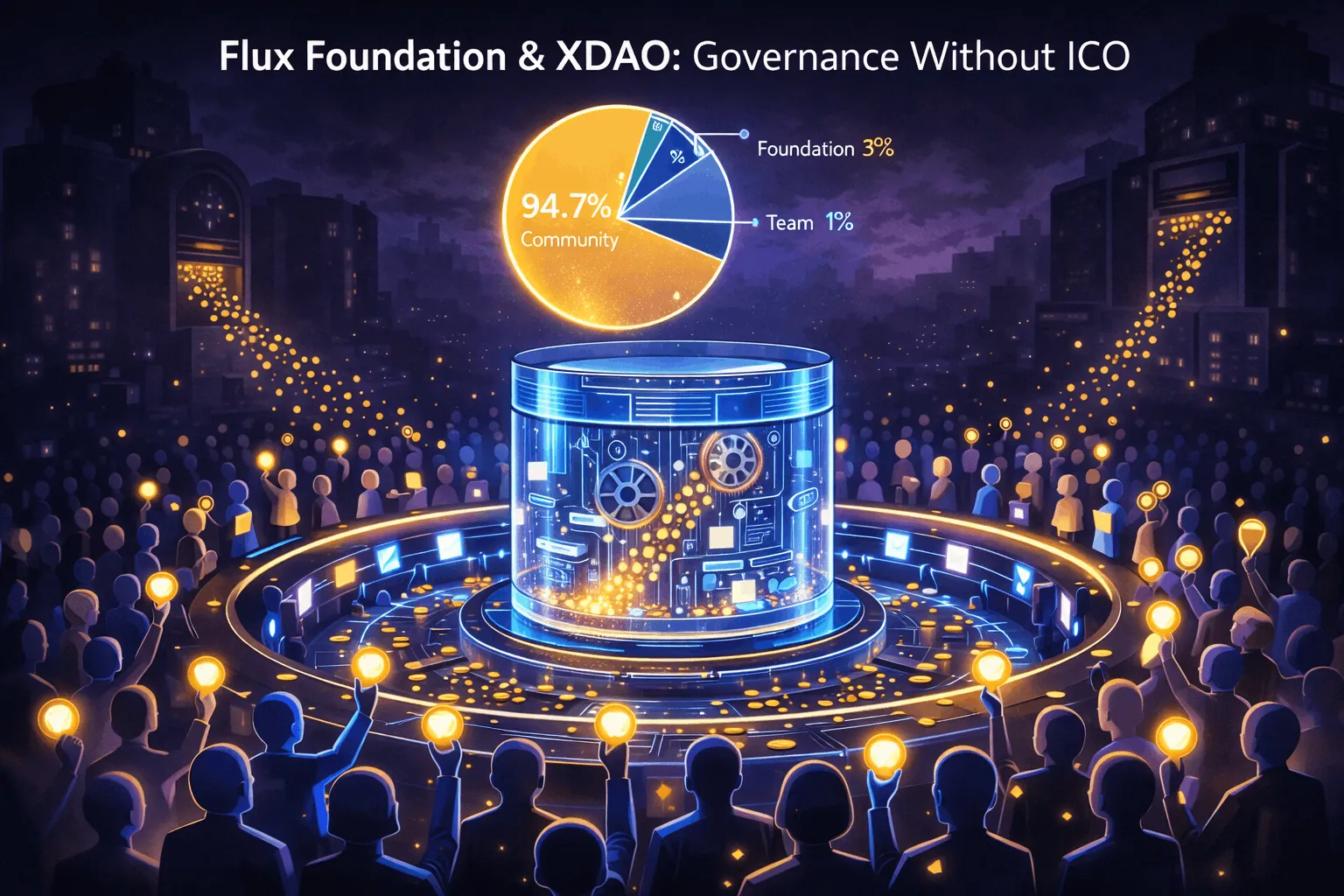
Flux has chosen a radically different path. The Flux Foundation holds only 2.9% of the total token allocation -- compared to team/investor allocations often exceeding 20-40% among competitors. Even more remarkably: no ICO, no IEO, no pre-sale has ever been organized. Funding comes exclusively from a fixed portion of block rewards, creating what Flux describes as a "yield-generating infrastructure" for continuous development.
On March 25, 2025, the ecosystem reached a major milestone with the announcement of XDAO 2.0, extending voting rights beyond node operators alone to include miners and stakers. This evolution aims to transform Flux into a "100% decentralized platform" where even the core team submits its proposals to a community vote.
This article analyzes Flux's unique governance architecture: its self-sustaining funding model, the XDAO mechanisms, and how this system compares to the giants of decentralized governance.
Part 1: The Actors -- A Foundation Without Massive Treasury
Flux Foundation: The Anti-DAO Model
Unlike traditional blockchain foundations that accumulate treasuries via ICOs or VC allocations, the Flux Foundation operates on a continuous-flow model. The official RunOnFlux site states: "Community governed and wholly transparent, the Flux Foundation serves as a sustainable growth engine for the ecosystem. The Foundation receives a fixed portion of block rewards, acting as a consistent revenue stream to fund network growth through yield-generating infrastructure."
FLUX token allocation:
| Entity | Allocation | Typical Comparison |
|---|---|---|
| Users (miners, node operators) | 94.7% | 40-60% typical |
| Flux Foundation | 2.9% | 15-30% typical |
| Exchange Listing / Liquidity | 1.7% | 5-10% typical |
| Flux Team | 0.7% | 10-20% typical |
This distribution, documented by CoinMarketCap, contrasts sharply with projects like Solana (48% foundation/team), Avalanche (42% team/foundation), or even Ethereum at its inception (17% team + foundation).
The Yield-Generating Funding Model
After the PoUW v2 fork of October 2025, each 30-second block allocates 0.5 FLUX to the Flux Foundation out of the 14 FLUX distributed. This represents approximately 1,440 FLUX daily, or roughly 43,200 FLUX monthly at current prices.
This constant flow presents structural advantages:
- 1
Predictability
Funding is deterministic, independent of market conditions.
- 2
Alignment of interests
The Foundation benefits directly from the health of the network.
- 3
Transparency
Every allocation is visible on-chain.
An official Flux Medium article emphasizes: "Flux development is also safe from the next bear market as the Flux Foundation has sufficient resources to build throughout a potential multi-year crypto winter."
Leadership Team and the Foundation
The Flux Foundation operates distinctly from InFlux Technologies, the commercial entity. Daniel Keller (CEO), Tadeas Kmenta (CIO), Jeremy Anderson (CTO), and Davy Wittock (CBO) lead InFlux, while the Foundation maintains community governance.
Davy Wittock, also identified as Flux Foundation Chair in the ecosystem mapping, combines the roles of business development at InFlux and leadership within the Foundation. This hybrid structure enables efficient coordination while maintaining a separation of responsibilities.
Part 2: Technical Architecture of XDAO Governance
XDAO v1: The Foundations (January 2022)
The XDAO system was launched in January 2022, marking Flux's entry into on-chain governance. Daniel Keller announced: "The time to rule is here! The Flux xDAO is live, empowering the Flux community to submit and vote on proposals for the future of Flux."
XDAO v1 Mechanism:
- •Proposal submission: Open to all, for a fee of 200 FLUX (paid to the Foundation)
- •Voting period: 7 fixed days
- •Quorum: Minimum 30% of total votes required
- •Majority: Simple majority for approval
- •Voting power: Reserved for node operators
Vote weighting by node tier:
- •Cumulus: 10 votes per node
- •Nimbus: 25 votes per node
- •Stratus: 100 votes per node
This structure tied voting power to network contribution: the more computational resources an operator provides, the more weight their vote carries. As the Flux wiki explains: "In order to vote you will need to login with your ZelID which is used for verification of voting power."
Major decisions via XDAO v1:
- •Allocation of Foundation funds for community marketing
- •Claim rules for parallel assets on exchanges and mining pools
- •Technical orientations of development
XDAO 2.0: Democratization of Governance (2025)
Announced in March 2025 and detailed in July 2025, XDAO 2.0 represents a major overhaul aimed at extending participation beyond node operators.
New XDAO 2.0 vote structure:
| Category | Voting Mechanism |
|---|---|
| Solo Miners | 1,000 FLUX staked = 1 vote |
| Pooled Miners | FLUX in LP for defined period = votes |
| Cumulus operators | 1,000 FLUX = 1 vote |
| Nimbus operators | 1,000 FLUX = 12.5 votes |
| Stratus operators | 1,000 FLUX = 40 votes |
The official article states: "Anyone holding $FLUX (on any chain) will receive these governance tokens in a 1:1 relation to their Flux holdings. This will enable miners and regular Flux holders to participate in voting on the XDAO."
Key innovations of XDAO 2.0:
- 1
Vote Power Cap
Capping to balance large and small holders, preventing whale domination.
- 2
Core team decentralization
"The core team will no longer be the point of contact for consensus and development changes; they will submit proposals to the XDAO like anyone else, making Flux a truly 100% decentralized platform."
- 3
Parallel Asset governance
The choice of future PAs will be decided by community vote.
- 4
Faster timeframes
Adjusted timeframes for quicker decisions.
Technical Comparison with Other DAOs
| Feature | Flux XDAO | Uniswap DAO | Aave DAO | MakerDAO |
|---|---|---|---|---|
| Required quorum | 30% | 4% of supply | 2-3% by type | Variable |
| Proposal cost | 200 FLUX (~$30-50) | 10M UNI (~$50M) | 80-130K AAVE | Complex |
| Voting period | 7 days | 7 days | Variable | Variable |
| Delegation | No (v1) / Yes (v2) | Yes | Yes | Yes |
| Quadratic voting | Cap in v2 | No | Explored | No |
Flux's low entry barrier (200 FLUX vs. millions in tokens for Uniswap) fosters more democratic participation, while the high quorum (30%) ensures legitimacy of decisions.
Part 3: Market Implications and Positioning
Advantages of the Flux Model
1. Bear Market Resilience
The absence of dependence on a massive treasury in native tokens protects Flux from situations where projects must sell significant quantities to fund development, creating downward pressure. The yield-generating model ensures funding proportional to network activity, not to token valuation.
2. Team-Community Alignment
With only 0.7% team allocation, Flux's founders are among the least dilutive in the industry. This structure reduces conflicts of interest and naturally aligns incentives: the team thrives if the network thrives.
3. Immunity to Governance Attacks
Attacks such as the "Compound Golden Boys" incident ($24M diverted) rely on rapid accumulation of tokens to vote on malicious proposals. The Flux model, where voting power depends on network contribution (nodes, mining), makes these attacks significantly more expensive: an attacker would need not only to accumulate FLUX but also operate substantial infrastructure.
Challenges and Limitations
1. Limited Treasury Size
Flux cannot fund massive initiatives like Avalanche's $250M in grants or Uniswap's multi-billion-dollar programs. Projects requiring significant capital must find alternative financing.
2. v2 Governance Complexity
Extending voting to miners and stakers creates operational complexity. The weighted voting system (Stratus = 40x Cumulus) may be perceived as favoring the most capitalized operators.
3. Historical Participation
Like most DAOs, Flux faces the challenge of voter apathy. The 30% quorum is ambitious compared to Uniswap's 4%, which can block legitimate proposals if participation is insufficient.
Positioning within the DAO Ecosystem
The Flux model represents a distinct archetype from mainstream DAOs:
| Archetype | Examples | Characteristics |
|---|---|---|
| Treasury Giants | Uniswap, Mantle, Optimism | $2B+ treasuries, massive funding |
| Protocol DAOs | Aave, MakerDAO | Governance of critical DeFi protocols |
| Yield-Based | Flux | Continuous funding via block rewards |
| Collector DAOs | PleasrDAO, ConstitutionDAO | Collective asset acquisition |
Flux positions itself as an alternative to the dominant model where massive treasuries, often originating from ICOs, fund development. This approach may resonate with communities valuing distribution equity and long-term sustainability.
Part 4: Perspectives and Future Developments
XDAO 2.0 Roadmap
The transition to XDAO 2.0 involves several phases:
2025:
- •Deployment of the new voting system
- •Introduction of 1:1 governance tokens
- •Activation of voting for miners and stakers
- •Implementation of the vote power cap
2026 and beyond:
- •Refinement of mechanisms based on community feedback
- •Potential exploration of vote delegation
- •Integration with PoUW v2 evolutions
Success Indicators to Monitor
To evaluate the health of Flux governance:
- 1
Participation rate
Percentage of tokens/nodes participating in votes (target >30%).
- 2
Proposer diversity
Unique number of wallets submitting proposals.
- 3
Decision velocity
Average time between proposal and implementation.
- 4
Vote distribution
Concentration of voting power among top holders.
- 5
Community proposals adopted
Ratio of successful non-core-team proposals.
Open Questions
Will the XDAO 2.0 transition maintain cohesion? Extending voting to miners could create tensions if their interests diverge from those of node operators. Since the PoUW v2 fork eliminated GPU mining, this question is partially resolved but warrants attention.
Does the yield-based model scale? As the network grows and block rewards decrease (10% annually post-PoUW v2), Foundation funding will proportionally decrease. Long-term sustainability depends on the increase in FLUX value compensating for the reduction in emissions.
How does Flux position itself regarding DAO regulation? DAOs face growing regulatory uncertainty. Wyoming has created a legal framework for DAOs, but most jurisdictions lack clarity. The Flux model, where the Foundation and InFlux are distinct, offers some structural flexibility.
Is the Foundation's 2.9% allocation sufficient? Compared to mainstream blockchain foundations, this allocation is modest. If major initiatives (enterprise partnerships, geographic expansion) require significant capital, Flux may need to explore complementary mechanisms.
Conclusion
Flux's governance model represents a significant experiment in the DAO space: proving that a blockchain ecosystem can thrive without an ICO, without massive team allocation, and without a multi-billion-dollar treasury. With 94.7% of tokens distributed to users, 0.7% to the team, and Foundation funding through block rewards rather than reserves, Flux embodies a philosophy of radical decentralization.
XDAO 2.0 pushes this logic further by democratizing voting beyond node operators alone. The promise that "the core team will submit proposals to the XDAO like anyone else" represents a strong commitment toward truly community-driven governance.
However, this model involves trade-offs: limited funding capacity for massive initiatives, increased coordination complexity, and dependence on active community participation. Flux's success will depend on its ability to maintain high community engagement while navigating the technical and regulatory challenges of the DePIN sector.
For observers of the DAO space, Flux offers a valuable case study: an alternative to the dominant paradigm of massive treasuries, prioritizing sustainability and distribution equity over the ability to rapidly deploy capital. Time will tell whether this model can compete with the giants holding billions in treasury.
Sources and References
Sources & Further Reading
- RunOnFlux -- Official Site, Foundation Section
- RunOnFlux -- XDAO 2.0: Flux's Next Generation of Governance (July 2025)
- Flux Official Medium -- XDAO 2.0: Exploring Flux's Next Generation of Governance (December 2022)
- Daniel Keller Medium -- Flux XDAO: Get ready to rule the Kingdom! (January 2022)
- RunOnFlux Substack -- Restructuring Flux Governance with XDAO 2.0 (March 2025)
- RunOnFlux -- FluxNodes: Earn Rewards in a Global Cloud Network
- RunOnFlux -- Flux Wallets (Foundation Allocation)
- Flux Wiki -- FAQ: XDAO Voting (January 2022)
- CoinMarketCap -- Flux (FLUX) Token Allocations
- Flux Official Medium -- Flux, a Unique Player in Blockchain (August 2022)
- Flux Official Medium -- We, The People of Flux! (January 2022)
- SimpleSwap -- FLUX Crypto Price Prediction (March 2025)
- CoinLaw -- DAO Treasury Holdings Statistics 2025 (November 2025)
- CoinLaw -- Decentralized Autonomous Organizations Statistics 2025 (August 2025)
- Cryptopolitan -- Uniswap becomes the leading DAO, large treasuries raise governance attacks (January 2025)
- Blockchain Reporter -- Top 15 DAOs, Ranked By Treasury Size (April 2025)
- CryptoNews -- Best Crypto DAO Projects to Invest in 2025 (July 2025)
- Liquidity Provider -- 10 Best DAO Projects in 2025 (May 2025)
- AInvest -- Aave's Governance Crisis: A Defining Moment for DeFi (December 2025)
- InFlux Technologies -- About Us / Team
- HiTechNectar -- Web3 and Decentralized Cloud: Insights from Davy Wittock (June 2025)
- Brave New Coin -- Flux: Web3 Cloud Infrastructure (Davy Wittock) (July 2024)
- Medium (Marz Rock) -- Flux Major Revelations: 5min Recap (February 2025)
- IQ.wiki -- Flux Organizations
- ChangeNow -- Flux (FLUX) Review 2023 (February 2023)
- AInvest -- FLUX Surges 107.26% Amid Launch of New Ecosystem Features (August 2025)
- Blockchain Council -- Flux: The Future Of Web3 Infrastructure (September 2024)
Other articles you might enjoy
FLUX: The Complete Guide to the World's Largest Decentralized Cloud & DePIN
Comprehensive guide to Flux — the 'AWS of Web3'. 10,000+ nodes, 66+ countries, NVIDIA Partner, PoUW v2, FluxEdge AI/GPU marketplace, tokenomics, investment analysis, and full ecosystem overview.
FLUX / RunOnFlux: Complete Ecosystem Cartography — Institutional Investigation
Exhaustive institutional-level research document with verified primary sources. All strategic partnerships, products, tokenomics, case studies, governance, compliance, roadmap, and 100+ referenced sources.
Flux Abandons GPU Mining: Complete Analysis of the PoUW v2 Fork
The historic transition at block 2,020,000 that eliminates GPU mining in favor of a node-centric model. Technical analysis, economic implications, and what it means for DePIN.
FluxCloud vs AWS: 98% Cheaper, But at What Cost?
Comparative analysis of FluxCloud against AWS, Azure, and GCP. Real pricing data, technical trade-offs, case studies, and the AWS October 2025 outage that proved decentralization's value.